How to build a teamwork culture in students
In this day and age, where there are so many people around, we have little control with who we actually interact and talk to. Very often we live in an apartment house and barely even know most of our neighbors, what then will happen if you need to find out specific information or get help with writing your essay, you will simply be in trouble. The same applies to universities and schools. Very often in classes with 100 students or more people rarely interact with one another and simply go through the motions. It’s hard to get things done when working on your own, hard to get any discussion going and simply develop as a person. Professors and instructors should realize this. Companies and enterprises are also structured in the same way. They are basically a group of people that work together as a family in order to provide a good quality product to the rest of the world and to service people. One person can never achieve what a company does. Group work is very healthy for the reason that despite all the differences that the students might have, despite their own little idiosyncrasies that they have one common goal and they will do everything possible to achieve it. If you are assigned a specific task and are working in a small group you have to know your responsibilities and your own problems. Use your past experience as a guidepost to help you further and ultimately improve the things that were done wrong in the past. Know that when you are working closely with other individuals the most important thing to remember is how can I provide something that we all will benefit from, not what I have to take away from this situation or how can I look good with those people. It is crucial to let the teams with various assignments work independently. Giving them certain tips or advice on how to tackle a specific problem might be helpful in the beginning stages but afterwards more things should be done and they can only be done if groups work independently. Various kind of conflict between people can occur in all sorts of groups: during work, school, sports etc. Progress is defined by how we are able to deal with this conflict when it actually occurs. This can be a pretty challenging and on paper it might seem more ideal that in real life. But if the group works for a common goal and everyone in the group is ultimately doing their best in the own way then this kind of conflict is healthy and might lead on some new discovery or personal growth in people. It is our job as humans to move forward in life, keep developing. Developing both as individuals and in teams, interaction with other humans is pivotal to our survival. If you don’t have a lot of experience of working in a team, never worked that much in groups or preferred doing things on your own at your own pace you can find out a lot of information and get great help over at essaymoment.
UK Plans to Slam the Door On Corruption Suspects
17/07/2019: The British government plans to bar people facing graft charges from travelling to the UK, according to the outgoing High Commissioner, Mr Nic Hailey. His government, he said, was working closely with Kenya to repatriate illegally acquired Kenyan assets and had asked for the names of corruption suspects. Mr Hailey spoke during a farewell visit to Integrity Centre where he held discussions with the Ethics and Anti-Corruption Commission (EACC). He was officially welcomed by the Chair, Retired Archbishop Eliud, Wabukala, Commissioners and the CEO, Mr. Twalib Mbarak, whom he assured of his government’s support in the ongoing fight against corruption. Chairman Wabukala welcomed the British government’s support such as its Formulation of a Framework for the Return of Stolen Assets to Kenya, which he lauded as a deterrence “as there is no haven in Britain for illegally acquired wealth”. On UK’s plans to bar corruption suspects, he described it as a good mechanism in ensuring that such individuals remain within the investigation jurisdiction for prosecution. Mr. Mbarak thanked Britain for its support in developing an Anti-Corruption Policy Framework, which led to the signing of the Framework for the Return of Assets from Corruption and Crime in Kenya (FRACCK). He also highlighted the Commission’s benchmarking visit to UK to share experience and best practice with peer agencies such as the Serious Fraud Office, Metropolitan Police and The Crown Prosecution Service. A similar visit to National Crime Agency is scheduled for later this year. The UK had also supported law enforcement in Kenya by embedding an investigations advisor funded by UK Department for International Development to the Commission. In addition, it had dedicated an International Anti-Corruption Liaison Officer (UK National Crime Agency) at the High Commission to provide support and coordinate investigations with international dimensions. The CEO highlighted the following as some of the notable successes of the UK-Kenya partnership in the fight against corruption: Smith & Ouzman Case: Repatriation of assets worth about 43 million, whose proceeds were used to buy ambulances to support the health referral system. Anglo-Leasing Case: Preservation of assets owned by suspects in the Anglo-leasing corruption https://www.viagrageneriquefr24.com/viagra-naturel-femme-ginseng/ case. Information sharing: Expeditious sharing of information relating to high profile investigations Mutual Legal Assistance: Facilitating the expeditious processing of MLAs.
Former KenyaRe Director to Serve 3 Years In Jail For Fraud
17.06.19: A Former Director of Kenya Reinsurance Corporation Mr. John Faustin Kinyua has been sentenced to serve three years’ imprisonment without an option of fine by a court for fraudulent acquisition of public property. Anti-Corruption Court Magistrate Felix Kombo sitting in Milimani found Mr. Kinyua and his co-accused Ms.Njeri Mary Nganga Kimingi guilty on three counts of charges each. The two accused fraudulently acquired a one-acre piece of land and a house owned by Kenya Re at Karen and transferred it to a private entity. Mr Kinyau is serving another four-year sentence after being convicted in a separate case and failed to pay the fine of Ksh7,393,792. He was convicted of fraudulent sale of Kenya Re’s Property LR. 209/10611/106 House No. 70 situated at Villa Franca sold for Kshs 3,196,896. On June 12th, 2019, the trail magistrate Mr. Kombo ruled that the evidence presented in court by the Ethics and Anti-Corruption Commission (EACC) through the DPP proved a case against Mr. Kinyua and Ms. Kimingi beyond reasonable doubt. Mr. Kinyua will serve the sentence without an option of fine while Ms. Kimingi was fined Kshs 1.5 million or a jail term of one and half years in default. But for Ms.Kimingi, the court directed that the prison sentence is non-custodial. Investigations by EACC established that Kshs. 12,134,504 that was purported to have been paid by Rockhound properties Limited in 2005 for the purchase of the Corporation property were monies paid by United Insurance Company Limited and Alexander Forbes Insurance Brokers Ltd for premiums due to the Kenya Re Insurance Corporation.
Inclusiveness of Community Groups And Networks In The War on Graft
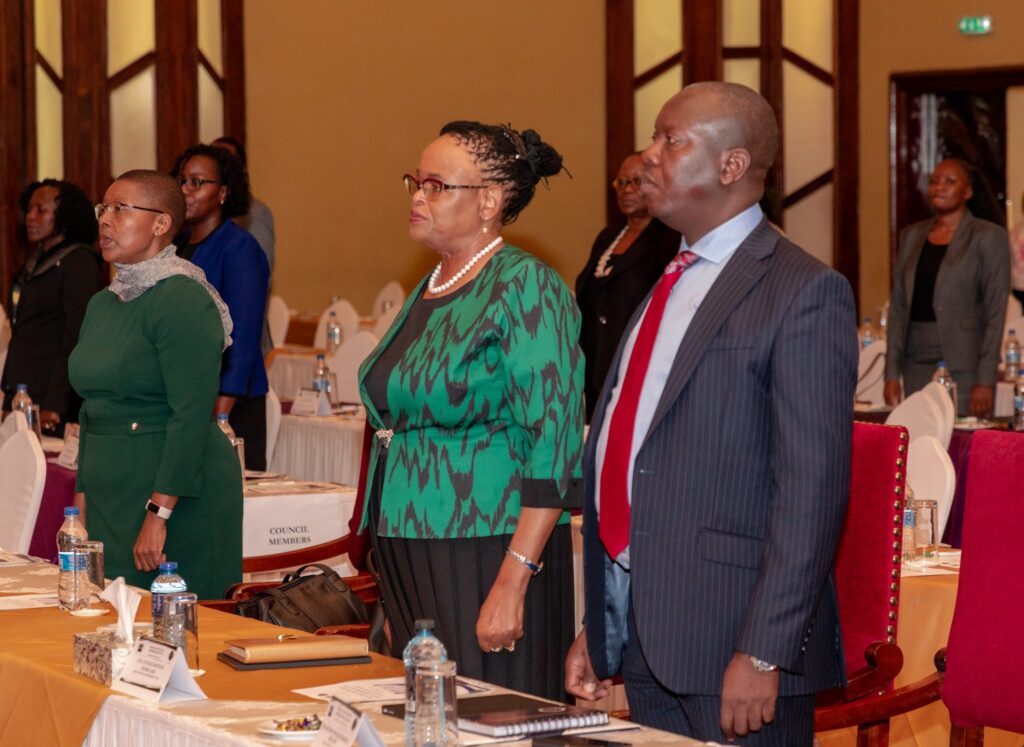
The Ethics and Anti-Corruption Commission has had a protracted engagement with diverse partners in its efforts to fight corruption and unethical conduct in Kenya. The engagement is premised on the Commission’s powers and functions under sections 11 & 13 of the Ethics and Anti-Corruption Commission Act, 2011 and other legal instruments, of enlisting the support of members of the public in the fight against corruption. This effort is paying dividends. For example, several corruption allegation reports have reached the Commission courtesy of whistle-blowers based at the community/grass-root level. Such groups have also been able to conduct social audits on a number of projects where they have flagged out inherent anomalies that border on corruption. Much more, these community organizations have organized and conducted sensitization programmes throughout the country either unilaterally or in partnership with the Commission, where they have reached out to hundreds of members of the public. In conformity with the anti-corruption content that these groups carry and disseminate, the Commission rebrands them and refers to them as Community Based Anti-Corruption Monitors (CBAMs). One enduring truth is that the war on corruption can be successfully won if all Kenyans are included in the on-going anti-corruption initiatives. This is because corruption affects and/or infects everyone in terms of provision of social amenities, economic and political stability, environmental implications and legal frameworks in the country. There have been divergent views on whether the fight against corruption should begin from the elite (the top) or from the general public (the bottom). However, the general consensus is that every Kenyan must be targeted. Whether in the public or private sector, state actor or non-state actor, religious group or secular association, state-employed or self-employed, government agency or private company, county government or national government…, right from the basic unit of the society, the family, we all have to fight corruption as if it’s annihilation all depended on us. To embrace this attitude of owning the fight against corruption is to spur every Kenyan to, in their private space, watch out to ensure an integrity-driven life at all times. In its 2018-2023 Strategic Plan, the Commission, under the strategic objective of ‘to enhance public education, communication and awareness’, has prioritized community networks as one perspective of achieving its mandate of fighting corruption. The projected networks include civil society organizations, community-based organizations, women and youth organizations, religious movements, table banking associations and professional networks among others. Across the country, the Commission continues to look out for these and similar networks which can be carriers for anti-corruption agenda. These networks are in turn trained, empowered and charged to partner with the Commission in the fight against corruption. Periodically, the Commission also monitors the effectiveness of CBAMs to encourage their diligence and to update them on the prevailing strategies for fighting corruption. The monitoring consists of short discussions and feedback exercises whereby challenges and concerns are raised and resolved. This way, both the Commission and CBAMs share the interest and burden of eradicating corruption in the society. Often, when there is a landmark determination of corruption cases in courts, especially where suspects are tasked to return public money, both the CBAMs and the Commission share commendations for the respective roles they played in the entire chain in the quest for justice. The Commission is appealing to all Kenyans to rally together and through their diverse networks, partner with the Commission in fighting corruption.
British Government Assures EACC of full Support in Graft Purge
29.05.2019: The British Government has assured the Ethics and Anti-Corruption Commission (EACC) of its full support in the fight against corruption. It assured of its commitment to ensuring seamless cross border investigations of economic crimes including asset tracing and recovery between Kenya and Britain. The British High Commissioner to Kenya His Excellency, Nic Hailey assured the Commissions Chairperson retired Archbishop Eliud Wabukala and the Chief Executive Officer, Mr Twalib Mbarak when he paid a courtesy call on the Commission at Integrity Centre on Wednesday 29th 2019. The two parties deliberated on several areas of partnerships to build the capacity of the Commission which will in turn give a boost in the fight against corruption in Kenya. The British High Commission will partner with EACC in several areas including, asset tracing and recovery, financial investigations and integration of technology in handling sophisticated economic crimes.
26 Year Old Risks Two Year Jail Term for Bribing KDF Officials
27.05.2019: A 26-year-old man who offered a bribe to the Kenya Military officials leading a recruitment exercise for Kenya Defence Forces in Kisumu will pay a fine of Ksh500,000 or serve a jail term of two years. Edward Obonyo Babu was found guilty of offering a bribe of ksh135,000 by the anti-corruption court in Kisumu. The accused was arrested by officers of the Ethics and Anti-Corruption Commission (EACC) who were monitoring the recruitment exercise discretely on 26th September,2016 at Madiany primary school playground in Rarieda within Kisumu county. He was subsequently charged in court and convicted today 27th may 2019 by the trial magistrate Julius Ngarngar for an offence of offering a benefit of Ksh 135,000 to Major Martin John Foro of Kenya Navy who was in charge of the recruitment exercise. The magistrate ordered him to pay a fine of Ksh 500,000 or serve two years’ imprisonment in default. The court further ordered that the 135,000 produced as exhibit be forfeited to the state. A total of nine prosecution witnesses testified during the trial.
Kiambu Governor among Suspects Quizzed In Corruption Probe
23.05.2019: The Ethics and Anti-Corruption Commission has raided several homes and offices of Kiambu County Governor Ferdinard Waititu, his family members, directors of private companies, and 10 senior employees of the government in relation to corruption allegations. Among the allegations the Commission is investigating are: Irregular award of tenders valued at Kshs. 588 million to companies associated with the Governor and members of his immediate family. Preliminary investigations show that contractors paid monies to senior county officials, their companies or relatives through proxies. Fraudulent acquisition of public funds. Conflict of interest. Money laundering. Commission officials recovered a number of documents during the raids that will aid investigations.
Commission Begins Audit of Centralized Procurement of ICT Equipment and Services by Ministry of ICT
23.05.2019 -The Ethics and Anti-Corruption Commission (EACC) has commenced the examination into the systems, policies, procedures and practices of Centralized Procurement of ICT Equipment and Services by the Ministry of Information, Communications and Technology. During the launch at the Ministry of ICT Headquarters in Teleposta Towers, on May 17th 2019, the CEO of EACC Mr. Twalib Mbarak said that the launch of the examination was necessary given that the centralized procurement system has implications on the service delivery at the National Government Ministries, Departments and Agencies (MDAs). Mr. Mbarak said there is need for appropriate management of the procurement process by the Ministry of ICT because the Centralized procurement adopted by the government is a strategy that comes about with a high volume of expenditure and increased competition from suppliers who may want to benefit from the ICT contracts. He added that there is need for the Ministry as the leader in the ICT sector, to demonstrate good governance, integrity, transparency and accountability in the procurement processes. This calls for development of robust systems and procedures of work that promote efficiency and effective service delivery, and that leaves no room for unethical conduct, Mr Mbarak, said. The Principal Secretary for Ministry of ICT, Mr Jerome Ochieng, welcomed the decision by the Commission to audit the procurement processes of his Ministry. He assured the Commission that the Ministry would support the exercise to ensure that the whole process is a success. This examination exercise is in fulfilment of the Commission’s preventive mandate as stipulated under section 11 (1) (g) and (i) of the Ethics and Anti-Corruption Commission Act, 2011 which provide that: On its own initiative, the commission may advise any person on any matter within its functions; and subject to Article 31 of the Constitution, monitor the practices and procedures of public bodies to detect corrupt practices and to secure the revision of methods of work or procedures that may be conducive to corrupt practices.
A Week-long Focus On Ethics and Integrity in Siaya
20.05.2019: “It is your character and morals that influence the people around you and the society at large.” This was EACC Chairman (Rtd) Archbishop Eliud Wabukala’s parting shot to the people of Siaya as the Commission concluded a week-long outreach programme in the County. Addressing a public baraza, he applauded the countywide programme, which covered 36 markets and shopping centres, and reached about 400,000 residents, sensitizing them on leadership ethics and anti-corruption issues. The outreach activities generated the following reports: Nine on embezzlement/misappropriation of public funds; six on civil and land matters; two on unethical conduct; seven on bribery and police harassment; 10 on maladministration; four on abuse of office; and one on penal code offences The programme also incorporated training for public and state officers. Some 38 Members of the County Assembly and 110 public officers of the National Government based in Siaya were taught leadership and integrity values. In addition, 48 County Executive Members benefited from the training. At the same time, the Commission disseminated 8,500 IEC materials and visited 10 learning institutions to instill in the youth and school managers a discipline of ethics and integrity. The programme reached 8,615 students and 259 teachers. The schools were urged to establish Integrity Clubs with the guidance of the Commission. The county leadership, led by Governor Cornel Rasanga, thanked the Commission for dedicating time to conduct preventive work in his county, and pledged his support to ensure his officers upheld integrity. Both the Governor and the Assembly Speaker signed an action plan as a commitment to lead the war on graft in the county. So far, the Commission has conducted similar programmes in Isiolo, Kilifi, Kwale, Laikipia, Tharaka Nithi, Vihiga, Nandi and Homabay, among other counties. It hopes to cover all the country’s 47 Counties. The weeklong programme took place from 13th -17th May 2019.
Zanzibar Anti-Corruption Authority Benchmarks at EACC
20th May 2019: The Ethics and Anti-Corruption Commission is hosting a 5 member delegation from Zanzibar Anti-Corruption and Economic Crime Authority, for a week-long study tour. The Commission will have an opportunity to showcase its functions to the delegation with hope of transferring knowledge and skills, to the members. The visitors met the Commission’s Chief Executive Officer, Mr. Twalib Mbarak, and the management team, who briefed them on the functions of each directorate and department. The visit ends on 24nd May, 2019.